Articles · 15 September 2026 · Lucy Pitt
Botsitting
UK workers spend 38% of their AI time making the output usable and 36% producing work with it. What botsitting costs, and who in your organisation is paying for it.
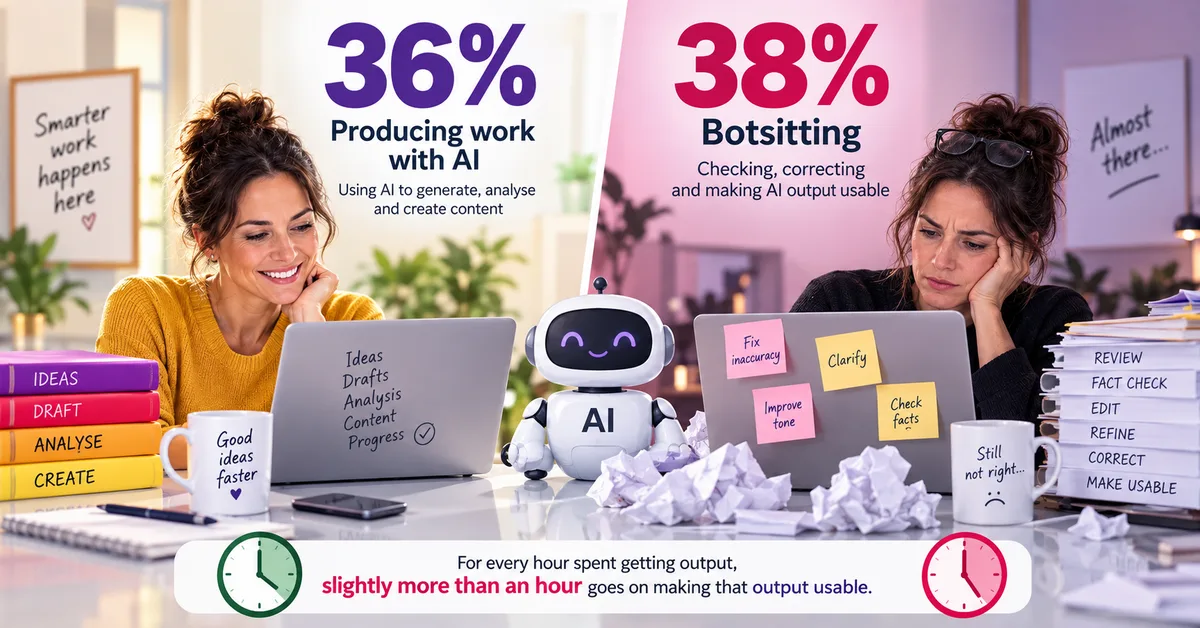
UK workers spend more of their AI time making the output usable than they spend producing work with it
Ninety per cent of UK digital workers use AI at work. Seventy-eight per cent say it makes them more productive, the highest of the three countries surveyed. They report saving roughly twelve hours a week through AI automation. And eighteen per cent say AI has significantly improved their organisation's performance, better than the United States at twelve per cent and Australia at ten, and nowhere near what ninety per cent adoption ought to produce.
Those are the UK figures from the Work AI Index 2026, published by Glean's Work AI Institute, which runs ahead of the study's global averages of eighty-seven per cent, eleven hours and thirteen per cent.
The distance between twelve hours saved and eighteen per cent improved is where this piece sits, because part of it is a cost nobody has budgeted for.
The hidden hours
The study surveyed 6,000 full-time digital workers across the UK, the US and Australia, 1,500 of them here, and asked something most adoption research skips: where do the saved hours actually go?
Glean's answer has a name. It defines botsitting as "giving AI the context it's missing, checking its output, debugging mistakes, rerunning prompts, and cleaning up confident-but-wrong answers it leaves behind".
The following figures are global rather than UK. Workers spend an average of 6.4 hours a week on it: 2.3 hours supplying context, 2.2 hours supervising output, 1.7 hours debugging. Thirty-six per cent of AI sessions need substantial rework or a full reset. Glean does not publish the UK equivalents as hours.
What it does publish for the UK is the split, and the split is the more useful number. UK workers spend thirty-eight per cent of their AI time botsitting and thirty-six per cent using AI to produce the work itself. Roughly an hour spent making it usable for every hour spent getting it. Seventy-seven per cent have corrected or redone AI-assisted work in the past month, and twenty-six per cent do it at least weekly.
None of this is waste. The checking is the job. A model cannot know which of four forecasts on the shared drive is the signed one, or that the tidy answer rests on the assumption the board rejected in March. Somebody has to supply that, and somebody has to notice when it is missing. The difficulty is that the work is absorbed into the working day without a name, a cost code or anybody whose job it is, so it never reaches the business case.
The verification gap
Raise the volume of AI-assisted work without raising the time to review it, and the review is what gives.
Glean calls the result botshitting, which is its coinage and not ours. It defines it as "shipping AI-assisted work they haven't adequately verified, don't fully understand, or couldn't confidently defend".
Seventy per cent of UK AI users report at least one of those behaviours, against sixty-four per cent in the US and sixty-nine per cent globally. Underneath the composite, forty per cent of UK users sometimes deliver work they could not explain if asked, thirty-four per cent use tools their employer has not approved, thirty-five per cent use approved tools in ways that break company policy, and twenty-four per cent have blamed AI for a mistake that was theirs.
On the narrowest measure, shipping work they have not fully checked, thirty-seven per cent of UK users say they sometimes do against thirty-six per cent in the US. The UK finding is not that we are worse. It is that we are no better, while doing more of the things that ought to help.
Policy and practice
Sixty-five per cent of UK workers have read their organisation's AI policy in full, against fifty-seven per cent in the US. Seventy-three per cent say they are confident in their organisation's AI strategy. Forty-two per cent say AI is embedded in core workflows across multiple departments, against thirty-two per cent in the US.
So the country with more policy awareness, more stated confidence and deeper embedding has the same verification problem as the country with less of all three. Glean's reading of that is careful and we would not go further than they do. Their words: "These numbers don't suggest that UK policies have failed. They show the limit of what a policy can accomplish on its own."
The limit is a practical one. A policy governs the moment before the work starts, naming the sanctioned tool, the data it may touch and the uses that are barred. The decision that settles quality comes much later and belongs to one person at their desk, choosing whether to trace a number back to its source or send the thing because the meeting starts in ten minutes. Permission and verification are different jobs, and most organisations have done the first as a document and left the second to individual judgement under deadline.
The courts have already tested where that lands. In 2025 the High Court warned that solicitors and barristers could face contempt proceedings over AI-generated material containing fabricated case citations, and the Solicitors Regulation Authority and the Bar Standards Board took the same line: verifying an authority belongs to the lawyer, not the tool. The question was never whether lawyers could use AI, but who stayed answerable for checking it.
People decisions
Forty per cent of UK workers say their organisation uses AI in performance evaluations. Twenty-nine per cent say it is used in hiring. Eighteen per cent say it plays a part in termination decisions. Asked about comfort rather than use, UK workers are more comfortable than their American counterparts on every decision type the study covered, including hiring, promotion and pay, and termination.
The study does not connect those figures to the botshitting ones, and neither should we. But it puts two facts in the same room. AI-assisted material is already informing decisions about people's careers. And seven in ten UK users admit to shipping AI-assisted work they could not fully defend. Whether those are the same pieces of work is the question no organisation we have asked can currently answer.
Implementation error
When something goes wrong, the account usually settles on whoever was at the end of the chain, on the grounds that they should have checked and they signed it off.
They did sign it off, and nothing here excuses a bad decision. But the more honest description is often implementation error rather than human error, because that person was handed the responsibility without the means to exercise it.
Look at the conditions the study reports. Half of UK workers say important information they need is not reachable through their AI tools. Sixty per cent rerun the same prompt through a second tool when the first answer is not good enough, which means reintroducing the task, repasting the inputs and reconciling several confident answers that disagree. Glean does not say whether that sixty per cent is UK or global, and these are not necessarily the same people. They are the conditions the study says are common.
Asking why the decision was that easy to get wrong gets you further than asking who got it wrong.
What leaders measure
One finding has nothing to do with nationality. Across the global sample, seventy-four per cent of workers at organisations that measure productivity alone report botshitting behaviours, against sixty-four per cent where productivity and quality are measured together.
This is an association and not a demonstration. Organisations that measure quality will differ from those that do not in size, sector and maturity, and nothing here shows that changing the measure changes the behaviour. It is still the kind of association to test in your own organisation, because if it holds, the fix costs nothing to try.
What to do about it
Glean's UK recommendations run to five points. Three cost nothing and involve buying no software, so those are the ones to restate.
Set review standards by risk, so that a meeting summary and a termination recommendation do not pass through the same scrutiny. Name one person accountable for each output who understands it and will stand behind it. Read repeated policy breaches as feedback rather than defiance, because people go round the approved tool when the approved tool cannot do the job.
We would add a fourth they do not make: budget the verification time explicitly, because costing botsitting at zero is how it eats the gains.
And we are dropping their fifth, which is to give approved tools the context they need. It is not wrong. It is the one that points at the product Glean sells, and the only one of the five an organisation cannot act on without spending money.
Source limits
Glean sells enterprise AI software aimed at the problem this report describes. That does not make the findings wrong, and it does explain which recommendation comes last. The botshitting figures are self-reported, so they are what people will admit to.
And we cannot tell you how old the numbers are. The two Glean posts we worked from were last updated on 29 and 31 July 2026, and Glean does not state anywhere we can find when the survey was in field. The full methodology sits behind a download form we have not been through, so we cannot vouch for the sampling beyond the headline figures. We are using them anyway, because the direction does not turn on a few months, and you should know that was a judgement rather than a gap we missed.
To Glean's credit, the study combines the survey with interviews and platform data, and it is careful about itself in places, noting that its tool-by-tool comparisons are correlational and show no tool causing anything. We are citing it because the sample is large, the UK cut is reported separately, and it asks what almost nobody else asks, which is what it costs to make AI output good enough to use.
That is the figure missing from most AI business cases we see. If yours counts the hours AI gives back without counting the hours spent making its output usable, it is measuring one side of the transaction.
The Work AI Index 2026 is published by Glean's Work AI Institute. UK findings are drawn from its UK edition, based on 1,500 UK digital workers within a global sample of 6,000. Drawn from glean.com/blog/work-ai-index-uk and glean.com/blog/work-ai-index-hidden-work, both last updated July 2026.
Where does your organisation actually sit?
PRISM answers with evidence rather than opinion.
Explore PRISM